Sunday, September 23, 2012
Hard day, Interesting discoveries

Sunday, September 16, 2012
Archiving Materials
An essential and seemingly very boring part of archiving is understanding the physical materials. Part of archiving is studying materials and identifying names, dates and donors for pieces. The other part is putting these identified materials away in high quality containers that protect the objects from damage. Every piece of the packaging is important as acids as well as natural chemicals that seem harmless can really damage a piece over time. Therefore, it is important that we utilize every precaution when dealing with these delicate and irreplaceable pieces. Using cotton gloves when handling anything that can be damaged by the oils and proteins on our hands is an important step to remember. Taking extra care with old newspapers and magazine can be more difficult than one would expect. And finally one of the most difficult tasks is to attempt to restore an item that has undergone damage from improper storing. Being mere interns, our abilities to restore a damages piece are very minimal, however, even the smallest tasks can be very difficult as we must avoid causing further damage.
The CJAHS is a very small organization, so buying thousands of the highest quality cardboard for boxing objects, or the latest photo negative scanner is not always an option. However, some expensive materials must be purchased, which is why I try to find innovative ways to recycle materials for some of the less important parts of archiving.
One day as we were organizing large boxes and storing many different objects in them, it became apparent that we needed a way to easily identify which objects were in what boxes without permanently labeling any of them. Writing on the boxes in pencil might have worked but would become messy if things needed to be erased. Still, we could not leave them blank. I noticed a pile of transparent small plastic photo protectors that had belonged to a series of WW2 era propaganda postcards donated to the CJAHS. The postcards were relocated into our files and did not need their protectors. I also found a large stack of stiff paper that was no longer being used either. So I decided to cut the paper to fit the plastic protectors and attach the plastic to the boxes. Now the accession numbers for all the objects in the box can easily be added and removed without risk of damaging the box itself.


The CJAHS is a very small organization, so buying thousands of the highest quality cardboard for boxing objects, or the latest photo negative scanner is not always an option. However, some expensive materials must be purchased, which is why I try to find innovative ways to recycle materials for some of the less important parts of archiving.
One day as we were organizing large boxes and storing many different objects in them, it became apparent that we needed a way to easily identify which objects were in what boxes without permanently labeling any of them. Writing on the boxes in pencil might have worked but would become messy if things needed to be erased. Still, we could not leave them blank. I noticed a pile of transparent small plastic photo protectors that had belonged to a series of WW2 era propaganda postcards donated to the CJAHS. The postcards were relocated into our files and did not need their protectors. I also found a large stack of stiff paper that was no longer being used either. So I decided to cut the paper to fit the plastic protectors and attach the plastic to the boxes. Now the accession numbers for all the objects in the box can easily be added and removed without risk of damaging the box itself.

While this may seem like one of the most boring parts of my work at the archive I actually quite enjoyed the process of discovering a cheap solution for a little problem. Also, it was satisfying to see all the boxes together with a uniform look. I hope that even though I do not have professional expertise, I can make some contribution to the organization of the archive.

Saturday, September 8, 2012
A Day with Photos

Chicago Japanese Christian Church Group Spring Tour
I also was able to recognize Mrs. Arai, giving me a better sense of the photographs origins. In the same collection I found photographs of the same individuals posing in front of various monuments in Washington D.C. I also found a photograph of the group at a Christian gathering with what appears to be many different individuals from a variety of churches. While at first the task appeared very daunting, as I began to put the pieces together, I was able to understand the history behind the photographs. It felt like the moment when you finally solve a multilayered puzzle.
As I explored further into this collection of photos, I came across some very interesting photographs of Tom Arai in the army. From his uniform and the dates listed on a few of the photos I was able to identify the year, which placed him in the Second World War. Furthermore, "Rome", "Genova" and "Pisa" were written on the backs of the photos. This was one of my most interesting discoveries, as I have recently visited Genova while studying at the John Felice Rome Center. Never would I have guessed that my work in the CJAHS archive would bring me all the way back to Rome.

Tom Arai in Pisa, Italy
Tuesday, August 28, 2012
Introduction
When I was about 14 years old I participated in the annual History Fair and decided to investigate a topic that was closer to home. Although my name is Alexandra Vasilou (both first and last being of Greek origin) I am the daughter of a Japanese American mother who grew up in Chicago. At the time, I had no connection to the Japanese American community. However, through my investigation into the history of Japanese Americans in Chicago, I was introduced to many organizations such as the Chicago Japanese American Historical Society (CJAHS).


The CJAHS is a volunteer, non profit 501(c)(3)
organization dedicated to document, preserve and share the complex history of Japanese Americans in Chicago. The organization was formed by Yoji Ozaki in the 1980s following the development of the exhibit, "Chicago Goes to War 1941- 45" with assistance from the Chicago Historical Society. The CJAHS continues their work though a comprehensive historical presentation about the Japanese American experience as well as through museum collaboration, a publication of personal stories from various authors titled "Voices of Chicago" and their archive.

Above is the president of the CJAHS in 1943 when she was a very young girl in an internment camp.
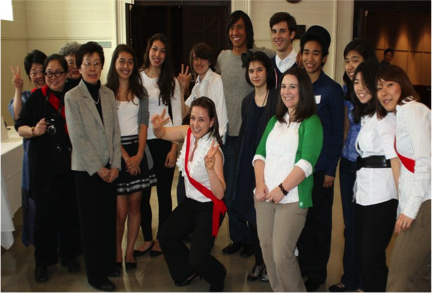
Pictured here are board members and volunteers working at one of the many events hosted by the CJAHS.
Following the end of my project I continued to maintain a relationship with the organization. Now, for the past year I have been assisting at the archive, organizing, identifying and accessioning a plethora of materials. This blog will be dedicated to recording my experience with the Chicago Japanese American Historical Society Archive.
Subscribe to:
Posts (Atom)